
Designing the 'Devi'

To me, it sometimes feels as if Bengalis, all around the globe just live their lives, however happy or miserable, in expectation of those four days of the year when they may forget the world and immerse themselves in celebration. And celebration is what it is. Though named 'Durga Pujo', religion takes a back seat and the occasion ascends to become a cultural celebration-a celebration of life, beyond race, creed, religion, language, even country.
This occasion brought to us this year an opportunity to be involved in the creative aspects of it. Our dear friend Suvro'da (Mr. Suvro Mukherjee) asked us to design the idol and the 'Pandal' (that is what we call the decorative structure housing the idol) for their gated housing community pujo. As an architect this was a completely different challenge from what we generally do, but the designer in us just could not ignore it.


The brief from the Pujo Committee was challengingly complex in spite of Suvro'da's clear ideas. Simply put, they wanted a 'Bonedi pujo' (the closest in English is, traditional) inside a 'Bonedi Jamindar Bari' (simply put, the traditional mansions of the Bengali Landlords of colonial Bengal). All recreated within a budget that would get a small community pujo the simplest of a pandal and a very basic run of the mill idol.
We started the process well in advance, studying all old Colonial buildings and famous landlord residences in and around Calcutta, keenly observing the structures, the decorative styles, the patters and especially the environment which we were to recreate.

Mapping the site gave us a clear idea of the area available for the pandal structure and as architects we could not ignore the basic safety considerations. A very careful planning ensued keeping in mind the easy approach for the fire tenders, easy and clear egress in case of an emergency and unobstructed access to the fire suppression water lines. Basic structural planning was done in consultation with the Decorators detailing out how the bamboos would support the main frame.

From our stack of research, painstakingly, each and every relevant decorative element and motif was sketched out and finally turned in to drawings needed for the artist to recreate them on site.
I can amusingly recall the remark by the astonished artist, when he was glancing through the huge set of drawings given to him: "I have never been given such detail drawings to work with just for a pandal decoration! It would really be hard on my part to go wrong anywhere on this!"


Interestingly, however, designing the idol was a different story altogether. Unlike the pandal, we had no reference and...no idea! Volumes of sketches were spent, months went before we could even be close to something that could satisfy both us and the clients. The Goddess needed to be in an Avatar of a simple lady of the house, clad in her traditional 'Aat-poure laal paar-sada saree' very typical of the image of the Bengali woman of an era we were trying to recreate. The Avatar being a tribute to our ladies who literally grow five pairs of invisible arms to juggle the million things in running a household smoothly but also the same woman who can take up weapons, if the need arises, to defend the same household she loves so dearly.


We as architects have always understood that any space we conceive needs light to be one of the protagonists. And for light to play its part, we must design the shadows.
An idea hit us through our discussions with Suvro'da, in trying to recreate the play of light and darkness of a typical dalaan of the Thakurbari (the courtyard of the jamidari residence). We designed a light tunnel in the ceiling of the pandal. Covering the opening with a transparent sheet that kept the rain out but not the sun and keeping reflecting surfaces on the four walls of the tunnel, let the sunlight to reflect and bounce and spread an aura inside which, according to a visitor to the pandal, "gave you goose-bumps!"
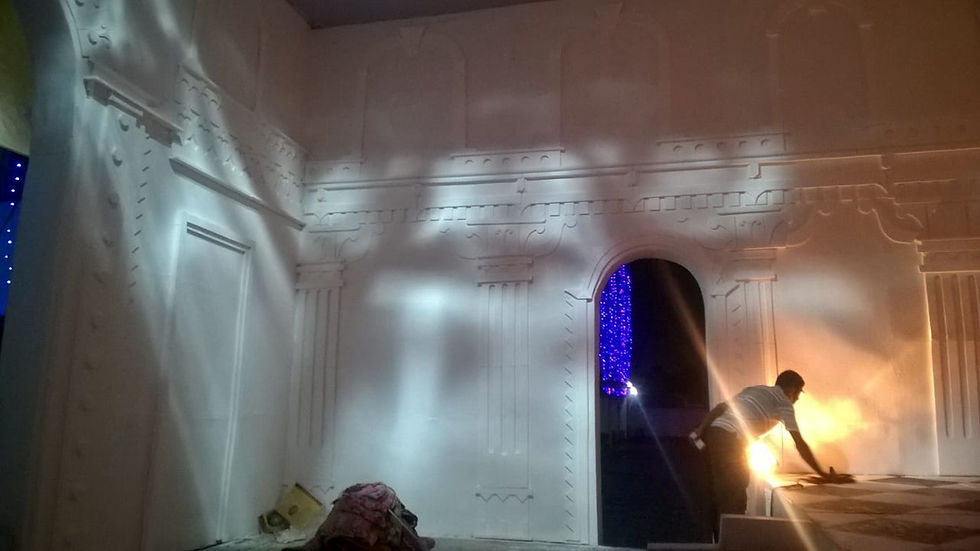

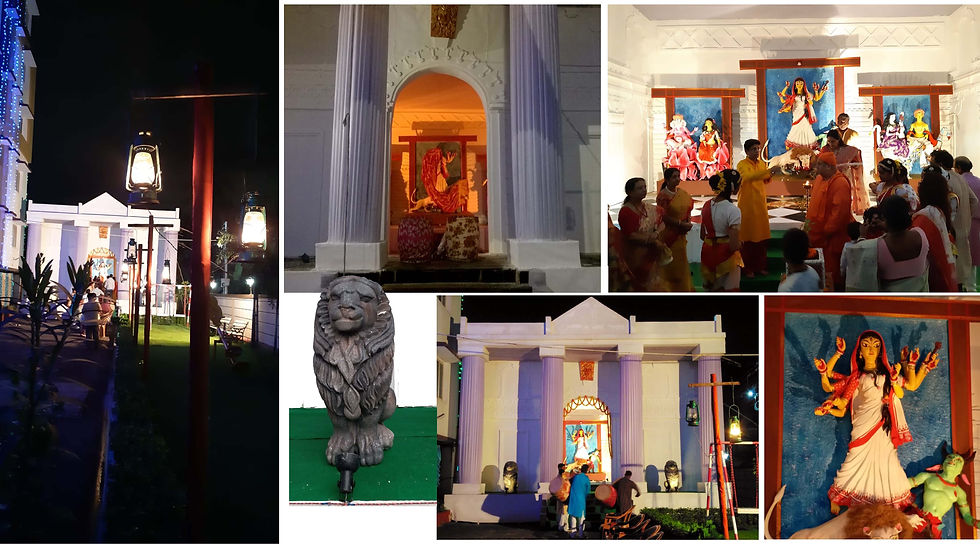
Finally the white paint we sprayed on the walls and motifs was mixed with a fire retardant as an extra bit of caution. It was a delight to see the white walls with shadows highlighting the profile our classical style decorative motifs and to know that it was safe!
In retrospect we however, being self critical, have identified flaws and quite a few areas of improvement. The wall decorations all around the inner side of the pandal should have been simpler, more modular and repetitive or should have been flexible to the changing site conditions. The cut outs should have been thicker to have achieved the depth perception better. The lighting outside was an issue. as we were more focused on the internal lighting, at the end, the options of exterior lighting became limited. Most importantly, we should, from the next time have a little change on our approach as we are to deal with building materials so different from a building construction which has a higher error margin.


Thank you @ Sneha!
Thank you @ Subhro Da. It is always a delight to work with you on any project. We shall surely try and put up a blog about the previous pujo.
Thank you @ Rwitwika!
Thank you @ Abhishek for the encouraging comments.
Thank you @ Ayush.